A stolen car is usually recovered in the first hours or not at all, which is why a car GPS tracker is judged less by its sticker price and more by how quickly it tells you the car moved. That decision now splits into four very different products: plug-in OBD devices that borrow the car’s power, magnetic battery trackers you can hide anywhere, hardwired units that stay on permanently, and no-subscription finder tags that solve a smaller problem than they appear to. This guide explains which type fits which driver, compares 11 picks on install, power, update behavior and year-one cost, and points to the deep-dive pillar pages instead of repeating them.
Why does every tracker on this list keep getting re-evaluated?
Because cellular networks, plans and hardware change faster than most buying guides update, and an old pick can quietly stop working when a carrier retires a network.
Car GPS recommendations decay for three reasons: carriers retire network generations, vendors change their subscription structures, and hardware revisions alter battery life and update rates. A tracker that made sense in 2022 can be the wrong buy in 2026 because its cellular module depends on a network that is being decommissioned. Our 2026 evaluation re-checks every shortlisted model against current vendor documentation, verifies the plan structure at the vendor’s own pricing page, and flags anything we could not confirm.
We also re-check the form-factor question before the product question. OBD plug-ins, magnetic battery trackers, hardwired units and finder tags answer different needs, and choosing the wrong category is the most common mistake we see in buyer questions. If you already know the category, the detailed pillar guides below carry the model-level analysis: OBD-II trackers, magnetic trackers, hardwired trackers and no-subscription options.
How do we score price, accuracy, and reliability?
Each tracker is scored on four buckets: total year-one cost, update and accuracy behavior, install and power demands, and how well the platform serves its intended use.
The cost bucket counts hardware plus the cheapest usable subscription plan for twelve months, because a $30 device with a $25 monthly plan is a $330 purchase. The accuracy bucket separates GPS fix quality from update frequency: a tracker that updates once a minute is far more useful for theft recovery than one that checks in every three hours, even when both use the same GPS constellation. Install and power covers whether you can fit it yourself, whether it borrows car power, and what happens when the car sits for two weeks. The use-fit bucket asks one question per pick: does this platform actually solve the job this driver described?
The scoring rubric and verification steps are published on our How We Test page. Where a specific behavior comes from vendor documentation rather than our own measurement, we say so in the article and link the source.
| Score area | What we check | Why it matters |
|---|---|---|
| Year-one cost | Hardware + cheapest usable plan for 12 months | Subscription, not device price, drives total cost |
| Update & accuracy | Stated update interval, GPS fix quality, signal behavior | Faster updates mean faster theft response |
| Install & power | DIY difficulty, power source, idle behavior | Wrong form factor fails in real use |
| Use fit | Alerts, history, diagnostics, family or fleet features | A great tracker for fleets can be wrong for a family car |
What are the 11 best car GPS trackers at a glance?
One table will not tell you which to buy, but it will tell you which category you are actually shopping for, and that is the decision that prevents most buyer regret.
| Pick | Product | Type | Install / power | Subscription model | Best for |
|---|---|---|---|---|---|
| Best overall | Bouncie | OBD plug-in | Plug into OBD port | Required monthly plan | Most drivers wanting one simple tracker |
| Best OBD value | Vyncs | OBD plug-in | Plug into OBD port | Annual plan, no monthly bill | Budget buyers who pay yearly |
| Best for teen drivers | MOTOsafety | OBD plug-in | Plug into OBD port | Required monthly plan | Parents coaching young drivers |
| Most versatile | Tracki | Magnetic mini | Magnet or clip, battery | Plans from about $9.95/mo | Multi-asset tracking, travel |
| Best magnetic recovery | LandAirSea 54 | Magnetic battery | Magnet, no wiring | Required, from about $19.95/mo | Theft recovery on cars and trailers |
| Best budget magnetic | Spytec GL300 family | Magnetic mini | Magnetic case, battery | Required subscription | Price-conscious asset owners |
| Best no-monthly-fee cellular | SpaceHawk | Magnetic battery | Magnet, no wiring | Annual prepay or month-to-month | Owners who want one bill a year |
| Best premium plug-in | Brickhouse TrackPort Pro | OBD diagnostic | Plug into OBD port | Required plan tiers | Diagnostics plus tracking |
| Best for Apple households | Apple AirTag | Find-My tag | No install, replaceable battery | No monthly fee | Finding cars near Apple devices |
| Best for Android households | Samsung SmartTag2 | Find-My tag | No install, replaceable battery | No monthly fee | Finding cars near Samsung devices |
| Best budget finder | Tile | Bluetooth tag | No install, replaceable battery | No monthly fee (optional premium) | Keys, bags and nearby cars |
The last three rows are finder tags, not cellular GPS trackers. We include them because they dominate “no monthly fee” searches, but they only work near a network of phones, so treat them as a separate category with separate limits.
Which tracker is best overall for most drivers?
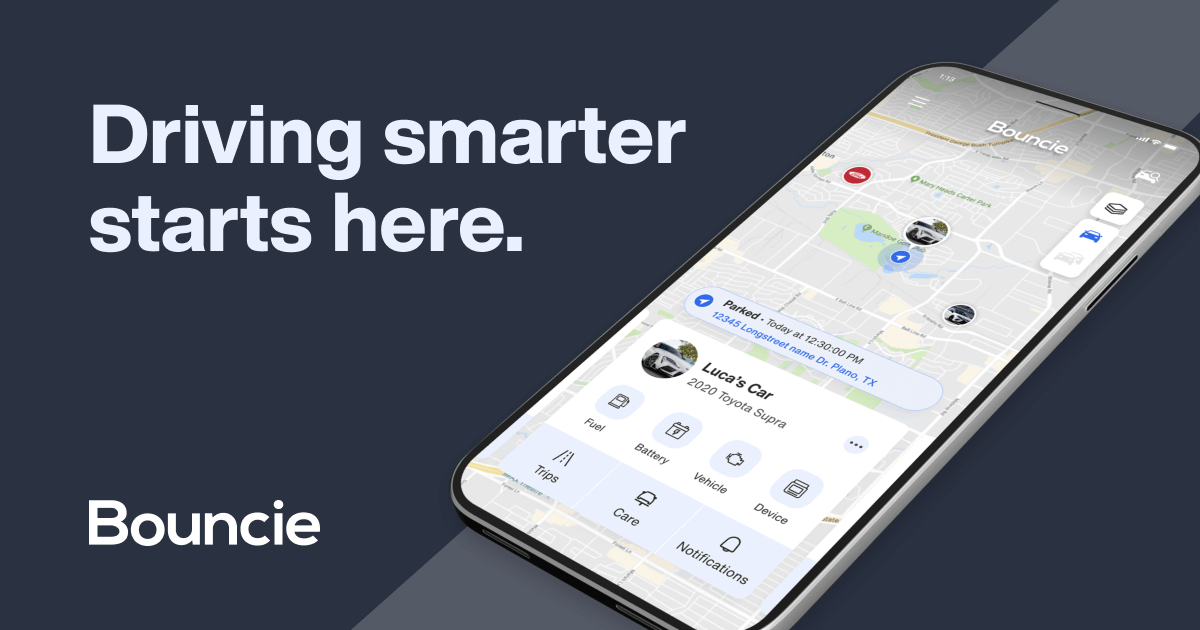
Bouncie is the best default for most drivers because it combines the easiest install with fast updates, clear alerts and a simple monthly plan at a reasonable price.
Bouncie plugs into the OBD-II port, needs no wiring, and its official platform covers live location, route details, geo-zones, driving events and accident detection. The pricing model is simple: a one-time device purchase plus a required per-device monthly subscription, with the official pricing page showing a lower rate per device when you run three or more. That structure makes it easy to predict year-one cost, which is exactly what most family buyers want.
What pushes Bouncie ahead for most drivers is restraint: no confusing tier ladder, no hidden add-on fees for the features that matter, and alerts that a non-technical owner can actually configure. Its weakness is that it lives in the OBD port, so a determined thief can unplug it, and some drivers dislike the visible plug under the dash. For a hidden, unpluggable option, a magnetic or hardwired tracker is the better category — details in our magnetic tracker explainer.
What is the best budget pick that still works well?
Vyncs is the strongest budget pick because its annual pricing removes the monthly bill entirely, and the device is included with the first year of service.
Vyncs sells annual plans that bundle the device, SIM and a year of service, so the buyer makes one payment instead of a hardware purchase plus twelve monthly bills. The official FAQ confirms that Vyncs Basic, Premium, Pro and Fleet plans have no monthly service fee, and it documents the update cadence per tier — the Basic tier samples GPS every 60 seconds and sends updates every three minutes while the engine runs, while the Pro tier samples every 20 seconds and updates every 60 seconds.
The catch is the same one that applies to every OBD tracker: the annual commitment is the price of the lower cost, and the update rate you get depends on the tier you buy. Budget buyers who pay attention to total year-one cost rather than the monthly sticker price will usually find Vyncs cheaper than a $25/month plan over twelve months.
Which tracker is the best no-monthly-fee option?
SpaceHawk is the best genuine no-monthly-fee cellular tracker we can verify, because its official model bundles a full year of service into the upfront price.
SpaceHawk’s site describes a no-monthly-fee option that pays for a year of active cellular service upfront, alongside month-to-month plans from $9.95. That is not magic — the cellular data still costs money, the vendor just moves the bill to the checkout screen. For owners who hate monthly subscriptions, one annual payment is a real convenience, and the magnetic, weather-resistant hardware suits cars, boats, trailers and equipment.
Buyers should read the fine print: “no monthly fee” usually means prepaid annual, not free forever. Finder tags from Apple, Samsung and Tile genuinely have no subscription, but they are not cellular GPS and only locate a car when a compatible phone is nearby. The full category breakdown lives in our no-subscription tracker guide.

What is the best tracker for families and teen drivers?
MOTOsafety is built around the family use case, with location history, speeding reports and a driver report card that parents can actually use day to day.
MOTOsafety plugs into the OBD-II port and targets exactly the family scenario: know where the car is, when the teen arrived, and whether they were speeding. The official site describes web and mobile dashboards, location history on maps, and coaching tools developed with driver-safety input, which makes it a better fit for parents than a general-purpose tracker with a weaker alert design.
Families comparing MOTOsafety with Bouncie or Vyncs should weigh report quality against price. MOTOsafety’s consumer plan costs more per month than Bouncie’s basic plan, but the feature set is narrower and more parent-specific. For a household that only wants “where is the car and was anyone speeding,” any of the three works; the family-focused alerts are the differentiator when you plan to coach a new driver.
Which tracker is best for small fleets and businesses?
For small fleets, Bouncie’s multi-device pricing and simple per-vehicle subscription make it the easiest starting point, with Vyncs Fleet as the annual-billing alternative.
Small-fleet needs are usually simpler than enterprise telematics: which vehicle is where, who drove it, and did anyone speed or idle too long. Bouncie’s pricing page shows per-device monthly rates with a discount at three or more devices, and its platform scales to a small fleet without forcing a sales conversation. Vyncs targets the same buyer with annual plans and a Fleet tier whose documented updates are faster than the Basic consumer tier.
Businesses that need hardwired, tamper-resistant units, driver ID or integration with dispatch software should look beyond consumer OBD trackers. That step-up is covered in our hardwired tracker explainer, which separates small-fleet pragmatism from enterprise requirements.
What does each pick really cost in year one?
Year-one cost is hardware plus the cheapest plan that actually delivers real-time tracking, and that total is usually two to four times the device sticker price.
| Pick | Typical device cost | Plan structure | Year-one reality |
|---|---|---|---|
| Bouncie | One-time device purchase | Required monthly, discount at 3+ | Device + 12 months of service |
| Vyncs | Bundled with first-year plan | Annual, no monthly fee | One upfront annual payment |
| MOTOsafety | Device sale price varies | Required monthly, no contracts | Device + 12 months of service |
| Tracki | Low device price | Plans from about $9.95/mo | Device + cheapest plan for 12 months |
| LandAirSea 54 | Mid-range device | Required, from about $19.95/mo | Device + 12 months of service |
| SpaceHawk | Higher upfront device | Annual prepay or from $9.95/mo | Upfront bundle or monthly plan |
| Finder tags (AirTag, SmartTag2, Tile) | Low device cost | No monthly fee | Device only, but limited range |
Prices move and vendors run promotions, so we verify plan pages during every review cycle and re-check them at publication. Pricing sources checked for this update: Bouncie, Vyncs, MOTOsafety, Tracki, LandAirSea 54, Brickhouse TrackPort Pro, SpaceHawk and Apple AirTag. The table is a framework, not a quote: your year-one number is the device price plus the plan you actually select, and the only way to compare honestly is to calculate both.
How do we test GPS trackers?
Our test process evaluates every tracker on install reality, location behavior, alert reliability, app usability and subscription math rather than on box copy.
The full methodology is documented on the How We Test page. In practice, each unit is evaluated for how long installation really takes, how the device behaves when the vehicle sits unused, how quickly location updates arrive when the vehicle moves, whether geofence and speed alerts fire without false positives, and whether the cheapest plan tier is genuinely usable for the intended purpose. Vendor-documented specifications are linked and separated from our observed experience.
One honesty rule applies to every pick on this page: if a claim comes from vendor documentation rather than our own measurement, the article says so. We do not publish scores we cannot defend, and we update this page when a carrier change, a price change or a hardware revision makes an old recommendation misleading.
FAQ: buying a car GPS tracker without regrets
Are GPS trackers for cars worth it?
For theft recovery and family oversight, yes — but only when the subscription cost fits your budget and the form factor matches your car. A tracker that is unplugged, out of battery or on a plan you resent paying is not worth it. Calculate the year-one total before buying.
Do car GPS trackers need a monthly subscription?
Cellular GPS trackers need a data plan, which is almost always sold as a subscription. Some vendors bill annually so there is no monthly charge, and a few bundle the first year into the device price. Finder tags like AirTag have no fee but are not cellular GPS trackers.
Is an AirTag as good as a GPS tracker for recovering a stolen car?
No. An AirTag only reports when an Apple device is nearby, which can be minutes or hours late, and it alerts nearby phones to its presence. A cellular GPS tracker updates over its own data connection and is designed for live theft response.
What is the most reliable car GPS tracker?
Reliability depends on the category: OBD plug-ins are dependable when the car is driven regularly, magnetic trackers depend on battery and update settings, and hardwired units are the most tamper-resistant. Our current overall pick for most drivers is Bouncie, verified against vendor documentation during this review cycle.
Still deciding between OBD, magnetic, hardwired or no-subscription tracking? Read the four pillar guides — OBD-II trackers explained, magnetic trackers explained, hardwired trackers explained and no-subscription trackers explained — or tell us about a wrong pick or outdated price through the contact page.