MOTOsafety is the OBD tracker designed around one job: helping parents coach a new driver. Where general trackers give you a location and a speed alert, MOTOsafety wraps the same hardware in a driver report card, speeding history and arrival alerts aimed at the family use case. This review evaluates MOTOsafety against its official product page, its published pricing and the family features that separate it from Bouncie and Vyncs. We do not claim independent road-test measurements; the evaluation is based on documented features, published pricing and owner-reported patterns treated as anecdotal.
What is MOTOsafety, and who is it for?
MOTOsafety is an OBD-II plug-in tracker with a family-focused app, built for parents monitoring teen and elderly drivers rather than fleet managers.
MOTOsafety’s official homepage describes a device that plugs into the OBD-II port and feeds a web dashboard and mobile apps with location, driving history and speeding information on maps, plus a driver report card for coaching. The product was designed with driver-safety input and markets itself around the freedom-versus-peace-of-mind trade-off that parents actually manage: the teen keeps the car, the parent keeps visibility.
It is a purpose-built family product, which means it is simpler than fleet telematics but more focused than a generic locator. Owners who want vehicle diagnostics, hidden tracking or multi-asset coverage should look elsewhere — MOTOsafety’s strength is the coaching loop, not the broadest feature list.
What do we know about setup, and how long does it take?
Setup is a plug-in plus account: insert MOTOsafety into the OBD-II port, download the app, and pair the device to the family dashboard.
The hardware step takes minutes on any car with a standard OBD-II port, and the app handles activation and the monthly plan. MOTOsafety markets itself to non-technical parents, so the account flow is designed around simplicity rather than fleet configuration. As with every OBD tracker, behavior depends on the car — port power while parked varies by model — and our OBD explainer covers what to check before trusting the device.
How much does MOTOsafety cost with its subscription?
MOTOsafety sells the device at a published price and charges a separate no-contract monthly service, making its consumer plan one of the higher monthly costs in this review set.
The official site shows a device sale price and describes the service as a simple monthly fee with no contracts. The monthly amount is confirmed on the vendor’s pricing page at purchase time; historically it has run well above Bouncie’s basic rate, which makes the year-one math — device plus twelve months — higher than the family-friendly competitors. MOTOsafety’s justification is the coaching feature set, so the cost comparison only makes sense if the parent will actually use the report card and alerts.
How does MOTOsafety install, and where does it not fit?
MOTOsafety plugs into the OBD-II port in minutes, which is simple but visible, removable and dependent on the car’s port power behavior.
The device is designed to stay plugged into the family car, so the visible plug is usually acceptable — the driver knows it is there. The limits are the same as every OBD tracker: a thief can unplug it, some cars power the port down with the ignition, and a car parked for weeks can experience battery draw if the port stays live. Families who want a hidden backup layer can add a magnetic tracker, but for teen oversight the visible plug is part of the point.
What does the MOTOsafety app offer day to day?
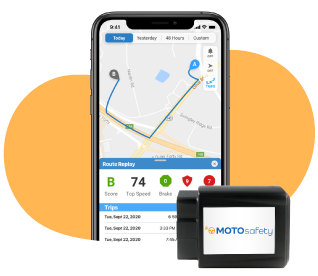
The MOTOsafety app and web dashboard cover live location, arrival and departure alerts, speeding history and a driver report card built for parent coaching.
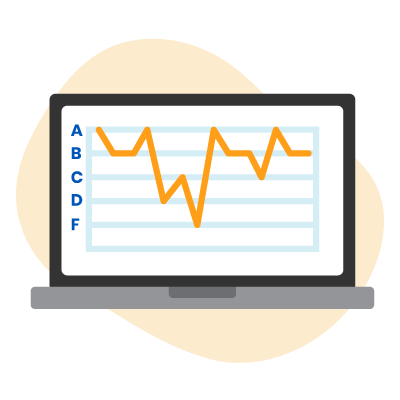
The core loop is family-specific: MOTOsafety tells you where the car is, when the driver arrived, whether they exceeded your speed expectations and how the trip looked overall, with history on maps and native iOS and Android apps. The driver report card turns raw speed data into a coaching conversation instead of a list of alerts, which is the feature generic trackers lack. Families should test alert reliability and notification speed on their own phones, because the coaching loop only works when the alerts arrive.
What do we know about accuracy and update speed?
MOTOsafety reports location and driving events through its platform, with update behavior that supports live maps and post-trip history rather than theft-grade pursuit.
Like other consumer OBD trackers, MOTOsafety’s accuracy follows GPS reception and its update cadence is set by the platform — sufficient for knowing where the car is and reviewing trips, not designed for chasing a stolen car in real time. Parents should treat MOTOsafety as a visibility and coaching tool, and pair it with a hidden tracker only if theft recovery is a separate concern. The vendor does not publish per-tier update intervals as transparently as Vyncs, so buyers should confirm current behavior in the app during the trial period.
Does MOTOsafety drain the car battery?
MOTOsafety draws power from the OBD port whenever it is live, so daily drivers are usually fine while long-idle cars can be affected.
The battery question follows the car: an always-powered port adds MOTOsafety’s draw to the vehicle’s parasitic load, and a car parked for two or more weeks with an older battery is the risk case. Daily drivers recharge through the alternator and rarely notice the device. If the family car sits unused for long stretches, monitor voltage or unplug the device, and review the guidance in our OBD explainer before blaming the hardware.
What do owners complain about most?
Owner themes center on the monthly price, occasional alert or app issues, and the visible OBD plug, all consistent with a purpose-built family tracker.
Repeated owner feedback across reviews and forums focuses on cost: MOTOsafety’s plan typically runs higher than Bouncie’s, and some parents conclude they pay for report-card features they rarely review. App and alert complaints appear across tracker brands and should be tested on your own phone during the trial, while the visible plug is a design trade-off rather than a defect. We treat these as anecdotal patterns and recommend confirming the current monthly price before committing, consistent with our How We Test methodology.
How does MOTOsafety compare with Bouncie and Vyncs?
MOTOsafety is the most family-focused OBD tracker, Bouncie is the simpler and cheaper all-rounder, and Vyncs is the budget annual-plan alternative.
| Model | Focus | Plan shape | Best fit |
|---|---|---|---|
| MOTOsafety | Teen and elderly driver coaching | No-contract monthly service | Parents who want a driver report card |
| Bouncie | Simple family location and alerts | Monthly; discount at 3+ | Most families wanting low-friction tracking |
| Vyncs | Location plus vehicle data | Annual, no monthly fee | Budget buyers who pay yearly |
For parents who will coach from a report card, MOTOsafety’s feature set justifies its price. For parents who mainly want “where is the car and did they speed,” Bouncie delivers most of the value at a lower monthly rate, and Vyncs offers the cheapest annual total with similar OBD data. If theft recovery matters more than coaching, compare magnetic alternatives such as Tracki and the LandAirSea 54 before deciding.
Who should buy MOTOsafety, and who should skip it?
Buy MOTOsafety for active coaching of a teen or elderly driver; skip it if you only want location alerts or the lowest possible monthly cost.
MOTOsafety fits families who will use the report card, review trips together and set expectations with the driver — the coaching loop is where the higher price earns its keep. It is a weaker fit for parents who just want a location alert (Bouncie covers that for less), for budget buyers who prefer an annual prepay (Vyncs), and for anyone needing diagnostics, hidden tracking or fleet features. Buy it for the family workflow, not for the hardware alone.
The bottom line for 2026: MOTOsafety remains the most purpose-built teen-driver tracker we cover, with the honest caveat that its plan costs more than simpler OBD rivals. If the report card changes how your household talks about driving, it is worth the price; if it will sit unread, Bouncie is the better buy.
FAQ: MOTOsafety review
How much does MOTOsafety cost per month?
MOTOsafety charges a separate no-contract monthly service on top of the device price; the exact monthly amount is shown on the official pricing page and has historically run higher than Bouncie’s basic plan. Verify the current rate before buying.
Is MOTOsafety good for tracking a teen driver?
Yes — the location, speeding history and driver report card are built for parent coaching. Test the alerts during the trial, because the coaching loop only works if notifications arrive reliably on your phone.
Does MOTOsafety work on any car?
It plugs into the standard OBD-II port found on US cars and light trucks since 1996. Actual reporting while parked depends on whether the port stays powered, so confirm behavior on your car.
Can MOTOsafety be used without a subscription?
No. The device reports over a cellular plan that MOTOsafety sells as a monthly service, so an active subscription is required for location, history and alerts.
Decide between MOTOsafety, Bouncie and Vyncs with the same criteria in the best car GPS trackers hub, and read the OBD explainer for the battery and port-behavior questions every family should ask.